Ministry of National Defense (MPAF)
updated 14 July 2025
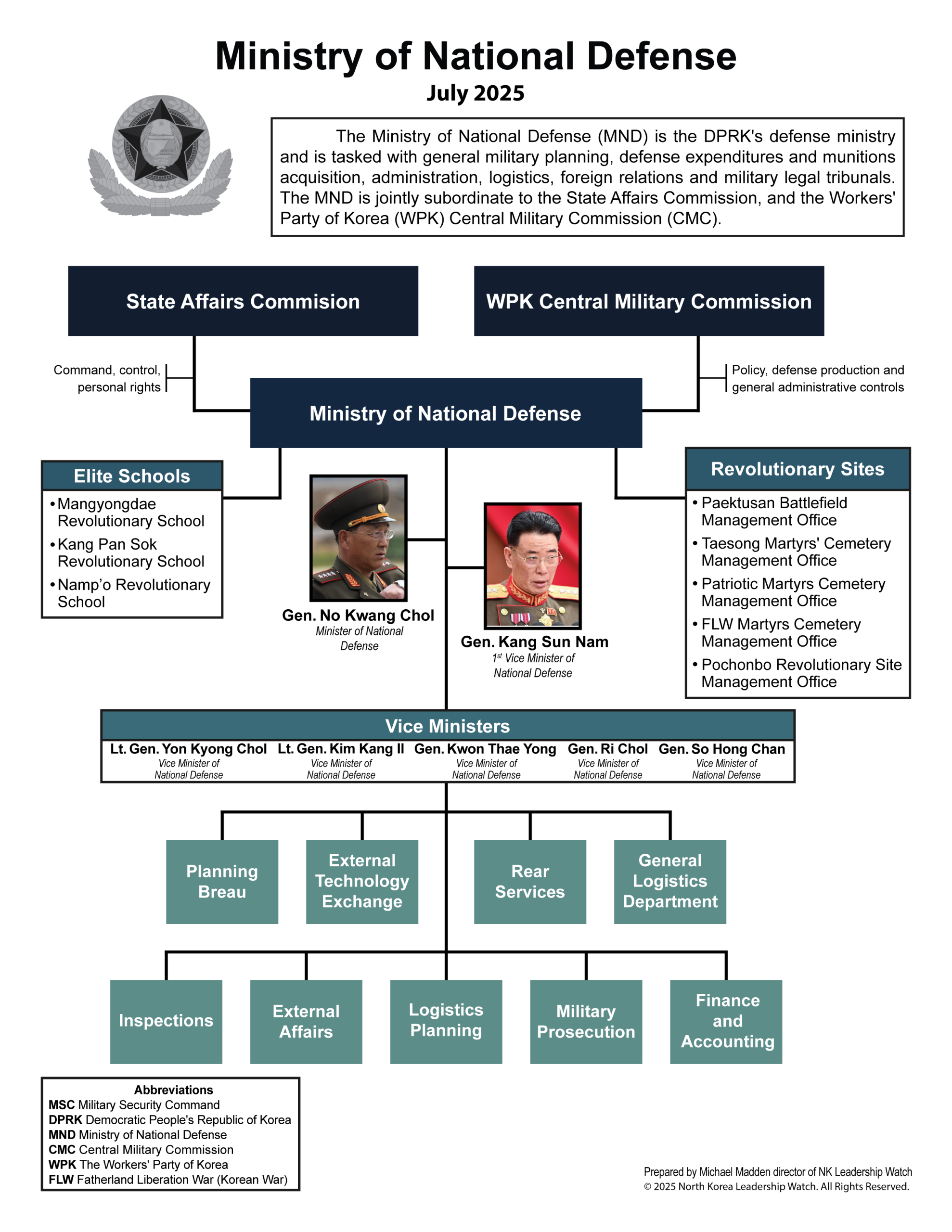
The Ministry of National Defense [MND] is the DPRK’s defense ministry. It is responsible for the Korean People’s Army’s [KPA] administrative affairs, logistics and rear services, processing munitions orders and conducting external affairs and diplomatic activity with foreign militaries.
MND is directly and jointly subordinate to the DPRK State Affairs Commission [SAC] and the Workers’ Party of Korea [WPK] Central Military Commission [CMC] and ultimately answers to the KPA Supreme Command. The MND’s primary mission, aside from representing the KPA externally (i.e. outside the DPRK), is managing and processing the manpower and resource needs of the country’s conventional armed forces and special operations forces [SOF] and has at least ten subordinate organizations. Notably, because of its rear service and administrative missions, the MND is the landlord (property owner) for the KPA General Staff and KPA General Political Department (i.e., North Korean armed forces).
MND’s most critical function in the KPA is its role in resource planning, allocation and finance. It serves as an administrative gatekeeper and interface in the defense acquisition process between the KPA General Staff and the WPK Central Military Commission and the WPK Munitions Industry Department. Bureaus, military units and other organizations subordinate to the MND and the KPA General Staff submit their requests/orders through the MND. After further formulation and input from other organizations in the KPA and WPK, MND passes them onto the CMC which technically authorizes munitions and defense production.
The MND also owns a number of productions units and trading companies involved in earning foreign currency through exports as well as domestic distribution. The MND and KPA General Staff own or have controlling stakes in at least 36 corporate entities and enterprises. Institutions involved in foreign currency earning activities are known in some sources, variably, as the “MPAF (MND) 44th Bureau” or the “MPAF’s (MND) 73rd Bureau.” The KPA General Political Bureau’s Organization Section (through its Foreign Currency Section) maintains fairly broad financial auditing and regulatory powers on KPA-owned companies. This occasionally leads to bureaucratic turfwars and financial malfeasance and can lend itself to small-scale corruption.
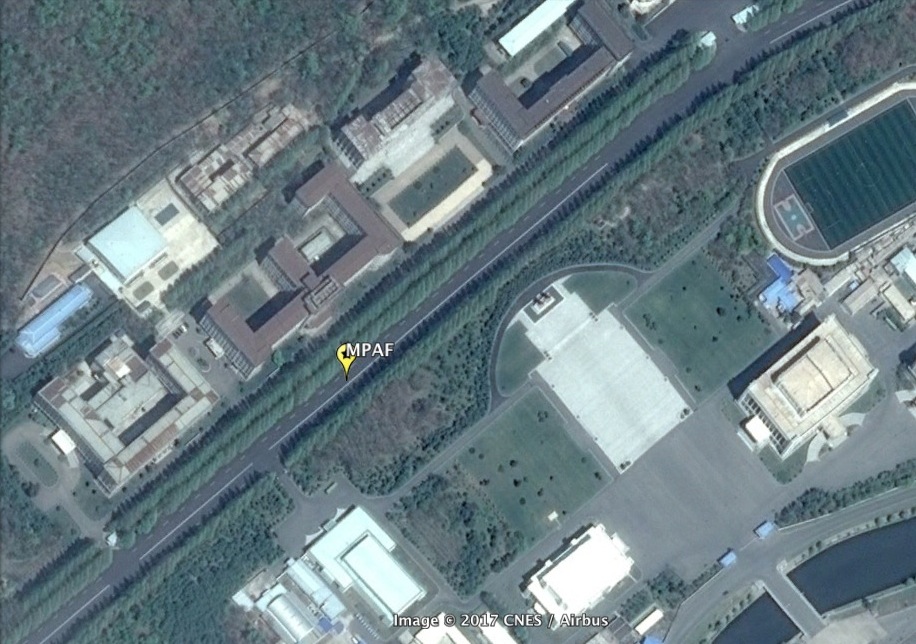
Ministry of National Defense and KPA HQ complex (Photo: Google image).
The MND External Technology Exchange Bureau links both with KPA-owned production units as well as an enterprises under the WPK Munitions Industry Department. It is involved in the purchase of IT, communications and weapons technology through the DPRK’s defense and military treaties with foreign countries. The MND External Technology Exchange Bureau is involved in sales of small arms and other munitions to foreign countries and coordinates munitions sales to allies like Russia.
The KPA General Logistics Department [GLD] (also known as the KPA General Rear Services Bureau) the largest of the MND’s subordinate organizations in terms of personnel size and geographical footprint. The GLD Organization and Planning Bureau is responsible for resource allocation in the whole of the KPA including food, energy, clothing, munitions and medical supplies. It links with other KPA bureaus within the MND and the KPA General Staff for resource planning.
The GLD controls a network of farms and factories which supply KPA units with food and clothing through the GLD Farm Bureau and GLD Provisions Bureau. Some of the GLD production units related to food and clothing supply products to DPRK civilians and products for foreign export. The GLD annd MND’s Construction Bureau control several KPA construction units (totaling at least one division). These brigades (called “soldier-builders” in state media reporting) are involved in the construction and maintenance of buildings, factories and other structures at KPA bases as well as the construction and maintenance of critical infrastructure in and around KPA units. During 2016, Kim Jong Un [Kim Cho’ng-u’n] ordered several construction and engineering units previously under the Ministry of People’s Security to be transferred to the MND.
The GLD Medical Bureau is responsible for hospitals and medical care in the KPA. It manages the KPA’s network of hospitals, clinics and medical centers. It is also responsible for the provision of pharmaceuticals and medical supplies to KPA hospitals and clinics. In addition to that the the GLD Medical Bureau is responsible for the education and training of physicians, nurses and other medical personnel deployed to KPA units through the Military Medical College and the Kim Hyong Jik Military Medical University.
The KPA Cadres’ Bureau is responsible for the promotions and demotions within the military. The Cadres’ Bureau’s main focus is on promotion and assignments of the KPA’s general-grade officers and commanders of regiments and divisions, as well as defense attaches posted to the DPRK’s foreign missions and embassies outside the country. The Cadres’ Bureau has a director, three deputy directors, two section chiefs and a senior WPK cadre and its main organization is its Screening Committee. The committee generates promotions order lists and vets mid-level and senior KPA officers for promotion using personnel data submitted by the KPA General Political Department. Once these promotions order lists are made, they are submitted to the incumbent Minister of the People’s Armed Forces and Director of the KPA General Political Bureau. Promotions are then handed over to the KPA Party [WPK] Committee and the WPK Organization Guidance Department’s senior deputy director responsible for military affairs. Representatives of these institutions then gather in a committee where they haggle and hash out officer promotions before submitting them to the Suryo’ng.
The MND Foreign Affairs Bureau is responsible for external relations and military diplomacy with foreign countries and their defense ministries. The Vice Minister for External Relations typically escorts senior KPA and MPAF delegations prior to their departure to foreign countries and coordinates relations with defense attaches stationed in the DPRK.
Institutional Ties and Standing
The MND is directly subordinate to the joint command and control of the SAC (the government/state) and the CMC (party). It is ultimately subordinate to the unitary command of KPA Supreme Commander (who is concurrently SAC and CMC Chairman, according to the DPRK Constitution and the Workers’ Party of Korea Charter). The MND links with the KPA General Staff, the KPA General Political Department and the Military Security Command.
Until the late 2000s, the MND was an umbrella organization for the KPA. The KPA General Political Bureau, the KPA General Staff, the Military Security Command, the KPA Reconnaissance Bureau and the Guard Command, were all organizationally under the defense ministry apparatus. This changed around 2007 with the expansion of the National Defense Commission [NDC] whereby these security organizations migrated out of the MND apparatus and were all subordinated to the NDC. In 2016, the NDC was downgraded to a temporary crisis management organization with the establishment, by constitutional amendments, of the State Affairs Commission.
Command and leadership
Gen. No Kwang Chol (No Kwang-ch’o’l) is current Minister of National Defense, appointed in October 2024. Gen. No previously served as Minister from 2018 to 2019. He has also served as a corps commander, head of a General Staff research institute and commander of the KPA’s 191st Intelligence Battalion.
Gen. Kang Sun Nam (Kang Sun-nam) is currently 1st Vice Minister of National Defense, appointed around December 2024. Gen. Kang previously served as Minister from 2022 to 2024. He is a former Vice Minister of National Defense, commander of the 108th Mechanized Division and Central Committee Department Director.
There at least five Vice Ministers, most of whom hold concurrent directorate positions in the MND apparatus.
See also: Baird, Merrily. Kim Chong-il Agonistes; Bermudez, Joseph S., Jr. The Armed Forces of North Korea London: IB Tauris, 2001; Gause, Ken. North Korean Civil-Military Trends: Military First Politics to a Point Carlisle, PA: Strategic Studies Institute USAWC, 2006; “Journal Views DPRK’s Military Organization,” by Yi Cho’ng-hun, SISA Journal (in Korean), June 6, 1996 pp 30-31; Oh, Kongdan, Ed., DPRK Policy Elites (Joseph S. Bermudez; Ken Gause; Ralph C. Hassig; Alexandre Y. Mansourov; David J. Smith) Alexandria, VA: IDA, 2004; Savada, Andrea M. (ed.) North Korea: A Country Study Washington DC: Library of Congress Federal Research Division, 1994; Yonhap News Agency. North Korea Handbook. Armonk, NY: ME Sharpe, 2003. p. 670-71
